




Don't miss a drop - Sign up for SMS notifications for exclusive offers!
Skip to content

Van Essen Instruments Diver-MOD

SKU AS339
$445.12

Free Shipping Available

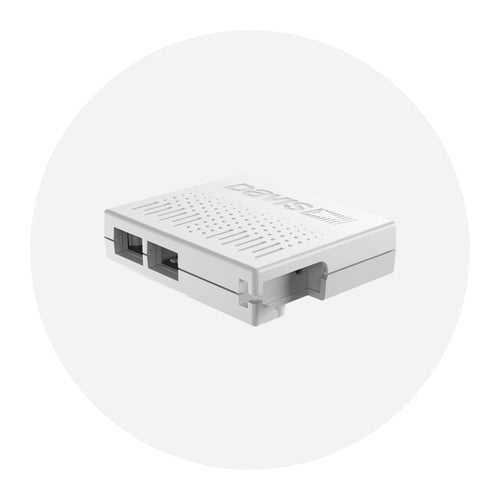
The Diver-MOD is the Modbus interface used to connect Divers to an RS485 network.

The Diver-MOD is the Modbus interface for Divers and is used to connect Divers to an RS485 network using the Modbus/RTU protocol. The Diver-MOD features a barometric sensor, which can be used to convert the Diver pressure in to a water level.

A typical Modbus configuration is illustrated in the figure below. In the schematic, two Diver-MODs are connected to a PC/PLC. This connection includes both data communication and power. The maximum Modbus cable length depends on the baud rate, the cable, the network configuration (2-wire or 4-wire), etc. A maximum length of 1000 meters can be achieved using the right components.

Features & Benefits Click here to learn more about the product.

Features

  • The Diver-MOD has a built-in pressure and temperature sensor for measuring air temperature and atmospheric pressure readings.
  • Read Diver memory.
  • Program the Diver sample interval.
  • Start and stop Diver.
  • Power is supplied by the Modbus network.

Benefits

  • No need for additional sensors to measure air temperature and atmospheric pressure.
  • No need for post-processing the pressure data.
  • No internal battery is required.
Applications Click here to view product applications.
  • SCADA Modbus/RS485 networks
  • Real-time monitoring of municipal water supplies
  • Monitoring water quality and quantity at mine sites
  • Monitoring water level and salinity of reclaimed water
Key Specifications Click here to view product specifications.

Casing

Dimensions (L × W × H) 65 × 50 × 35 mm
Material ABS
Protection classification IP65

Modbus

Communication RS485 half-duplex
Multidrop yes, max 8 devices

Power Consumption

External supply voltage +5 to +12 Volt
Stand-by current 2 mA

Pressure

Value Unit
Range 400 to 1100 cmH2O
Accuracy* ±2.0 cmH2O
Resolution 0.06 cmH2O

Temperature

Value Unit
Range -20 .. +80 °C
Accuracy* ±1.0 °C
Resolution 0.2 °C

*maximum

Support Documents Download the user manuals and specifications.

FAQ

The power requirements are 5 to 12 VDC. The power supply needs to be able to deliver at least effective 20 mA/peak 50 mA.

The integrated baro sensor can be used to compensate the Diver data for barometric fluctuations. The accuracy of the baro sensor is 2 cmH2O over a temperature range of 0 to 50 °C.

The International Protection Marking of the Diver-MOD is IP65. This means that the Diver-MOD is dust tight and protected against water jets.

The Diver-MOD can work with both a started Diver and non-started Diver. Moreover, the Diver can be started and stopped using Modbus communication.

The Diver-MOD is equipped with a barometric pressure sensor of which data can be collected using the Modbus system. The barometric compensation must be done by the back-end software/ supervisory computer.

The Diver-MOD can be used to integrate the Diver into industrial Modbus networks.

The Diver-MOD requires the Modbus RTU interface (Modbus Application Protocol Specification V1.1b3).

The power requirements are 4.75 to 13.5 VDC. The power supply needs to be able to deliver at effective 20 mA/peak 50 mA.

After powering on the Diver-MOD the baro-sensor can provide a measurement after 100 ms and the communication with the Diver can start after 100 ms.

The maximum length of the cable between the Diver and the Diver-MOD is 500 meter (1,640 ft).

The maximum length of cable between the Diver-MOD and the supervisory computer is 1,000 meter @ 9,600bps, see the RS485 specifications for more details.

Up to 8 Diver-MODs can be used in a Modbus network.

Modbus Protocol is a messaging structure developed by Modicon in 1979. It is used to establish master-slave/client-server communication between intelligent devices. It is a de facto standard, truly open and the most widely used network protocol in the industrial manufacturing environment. It has been implemented by hundreds of vendors on thousands of different devices to transfer discrete/analog I/O and register data between control devices. See also www.modbus.org/faq

Yes, you can read the Diver memory with the Diver-MOD.

The Diver-MOD allows you to read a real-time compensated value. If you read the Diver memory you will need a barometric data source to compensate the Diver data.

See theDiver-MODmanual for detailed instructions how to download data from a Diver using Modbus.

Data generated by a Modbus system cannot be imported by Diver-Office.

The Diver-MOD can only be used over asynchronous serial transmission RS485.

The following Divers can be used with the Diver-MOD:

  • TD-Diver (DI8xx)
  • Micro-Diver (DI6xx)
  • Cera-Diver (DI7xx)
  • CTD-Diver (DI27x)
  • Baro-Diver (DI800, DI500)
  • Mini-Diver (DI5xx)

The Diver Data Cable AS2xxx must be used to connect the Diver to the Diver-MOD.
For connecting the Diver-MOD to the Modbus system RS485 cables with a diameter from 3.5 to 7 mm are preferred.

The Diver-MOD contains a barometric sensor, but there are no datalogging capabilities for the barometric data. Real-time data that can be requested is Diver pressure, temperature, conductivity (if applicable), barometric pressure, and air temperature. Note that there is no compensated pressure. Compensation must be done by the supervisory computer.

The Diver-MOD will not operate within specifications if the temperature exceeds the operational temperature range of -20 to 80 °C.

Updated real-time values from the Diver can be read every 0.5 second.

This depends on factors such as:

  • How much of the Diver data is already copied to the memory of the Diver-MOD
  • The bitrate of the RS485 interface
  • The amount of data to be read

If the Diver data is already copied to Diver-MOD memory, a full memory can be read within one minute.

The standby power consumption is approximately 2 mA (no activity of Diver or RS485) and in active mode the average power consumption is approximately 10 mA.